Williams & Johnson Coffee Co.
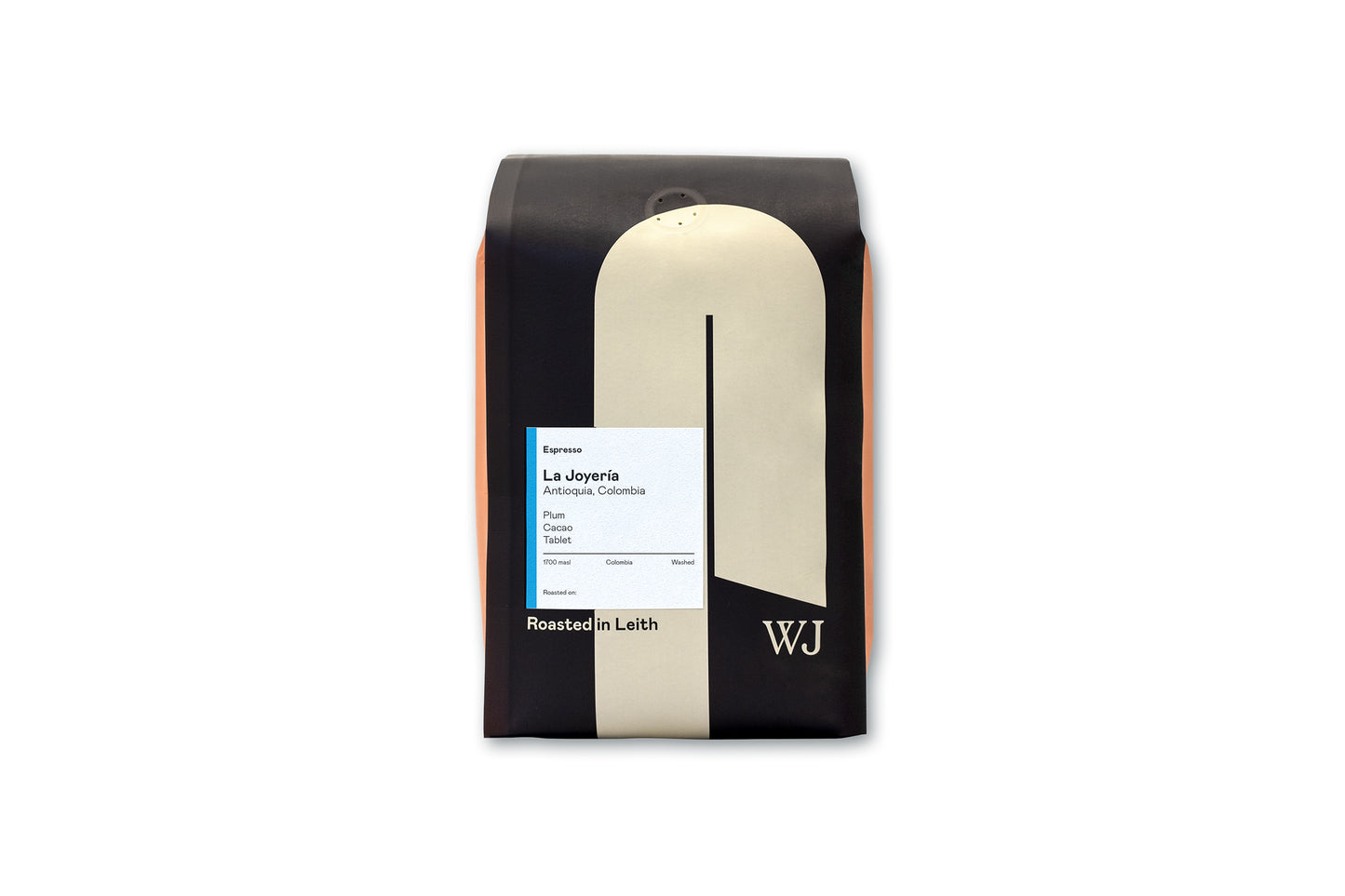
La Joyería, Colombia | ESPRESSO
La Joyería, Colombia | ESPRESSO
Couldn't load pickup availability
Share
|
Tasting notes: |
Plum, cacao and tablet |
| Origin: |
Antioquia, Colombia |
|
Processing: |
Washed |
|
Altitude: |
1,700 metres above sea level |
|
Varietals: |
Colombia |
| Owner: | Echavarria Family |
La Joyería is named for and processed at the main mill on the Santa Bárbara farm. The mill can process up to 7,000 bags of coffee; however, La Joyería makes up a very small percentage of this volume. It is also stored and milled separately from the volume production. Santa Bárbara Estate employs 60 people all year round, who on average earn 30% above the minimum wage. Half of these also receive free housing within the farm for themselves and their families. A further 1,200 pickers are hired during the main harvest, comprised mainly of farmers from around the Santa Bárbara Estate who pick coffee to supplement their income. Workers are generally long-term employees and have been with the company for more than 10 years. The Santa Bárbara Estate also runs an extensive scholarship and financial aid program for worker’s children as well as helping long-standing employees to acquire their own piece of land upon retirement.
La Joyería truly is ‘the jewel’ of the Estate. These lots are grown at an average altitude of 1,700 meters and are 100% Colombia variety. Each lot is composed of two days worth of picking; the coffee picked on the second day is added to the first after 24 hours fermentation and then left to ferment in the tanks for a further 24 hours. In this method of fermentation, the second batch raises the pH level of the fermentation tank, permitting
longer fermentation times without the acetic acid produced by bacteria at a lower pH level. Interestingly, the inspiration for the process was taken from small farmers throughout Antioquia and Huila, who often have two or three day fermentations as their farms are so small that one day’s picking is often not sufficient to make up an entire lot. Pedro and Leo have worked to perfect the process and adapt it for larger-scale production, which has resulted in a distinctive, even and controlled fruit-forward cup.